Table of contents
Learning about shapes is a foundational skill in early childhood education, as it helps children understand the world around them through visual recognition and comparison. These worksheets are designed to help young learners learn shapes in an engaging and age-appropriate way, combining observation, word recognition, and early writing practice. By encouraging children to identify and label shapes, we support cognitive development, vocabulary growth, and readiness for future math concepts. When children learn shapes through structured activities, they build confidence and curiosity at the same time.
Identifying and Writing Basic Shapes
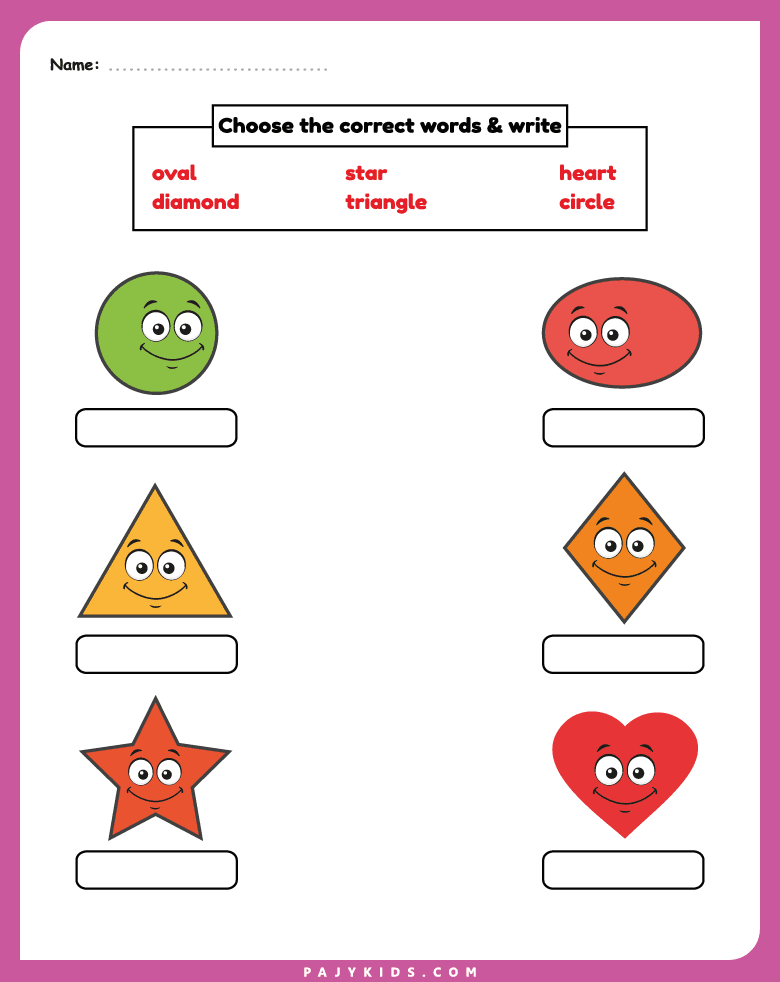
This worksheet focuses on introducing children to basic shapes such as the circle, oval, triangle, star, heart, and diamond. Children are asked to look at each shape, choose the correct word from a given list, and write it in the space provided. This activity helps kindergarten learners learn shapes by strengthening visual discrimination and reinforcing shape names through repetition. The worksheet also supports early writing skills, hand–eye coordination, and concentration, making it an essential tool for helping children learn shapes in a fun and meaningful way.
Exploring Advanced and Geometric Shapes
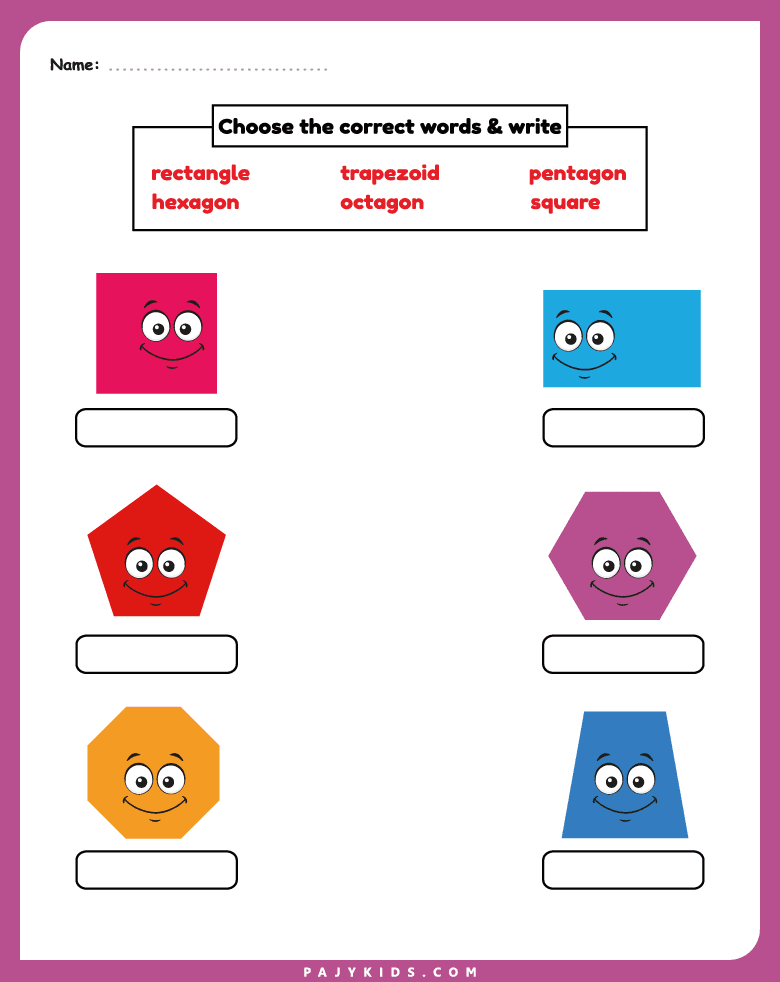
The second worksheet introduces more advanced geometric shapes, including the square, rectangle, pentagon, hexagon, octagon, and trapezoid. Children again practice matching each shape to its correct name and writing it independently. This worksheet encourages deeper thinking and comparison, helping children learn shapes beyond the basics. By working with these shapes, kindergarten students develop problem-solving skills and a stronger understanding of geometry, which lays the groundwork for future math learning as they continue to learn shapes step by step.
Addition Exercises for Kindergarten Beginners
In conclusion, these shape worksheets provide a balanced and effective approach to early learning by combining visual recognition, vocabulary, and writing practice. They help children learn shapes progressively, from simple forms to more complex ones, while keeping the learning experience enjoyable and structured. When children consistently learn shapes through well-designed activities, they gain essential skills that support academic success and everyday understanding of their environment.