Table of contents
Helping young children learn the alphabet is one of the most important steps in building a strong foundation for reading and writing. Early exposure to letters, sounds, and simple vocabulary prepares children for future academic success while also boosting their confidence and curiosity.
Alphabet flashcards for kids are a wonderful, engaging way to introduce these concepts in a playful and stress-free manner. The materials presented here feature bright, friendly illustrations paired with both uppercase and lowercase letters, making them especially appealing for preschoolers and kindergarten learners.
Whether you’re a parent, homeschooler, or teacher, these types of activities can turn everyday learning into an enjoyable bonding experience.
What This Activity Teaches Children
Alphabet flashcards are more than just simple learning tools they support multiple areas of early childhood development.
Letter Recognition
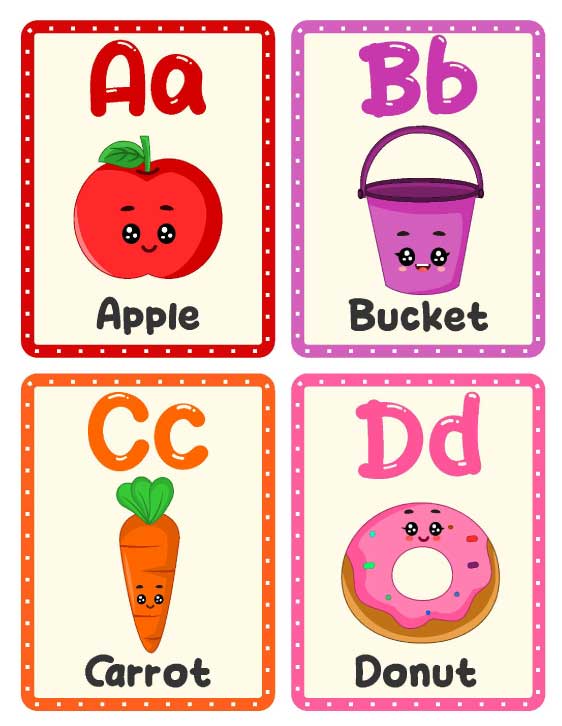
Children are introduced to both uppercase and lowercase letters, such as “Aa” for apple and “Bb” for bucket. This dual exposure helps them understand that letters can appear in different forms while representing the same sound.
Phonics Awareness
Each card pairs a letter with a familiar object (like “C” for carrot or “D” for donut). This strengthens the connection between letters and their corresponding sounds, a key component of early reading skills.
Vocabulary Building
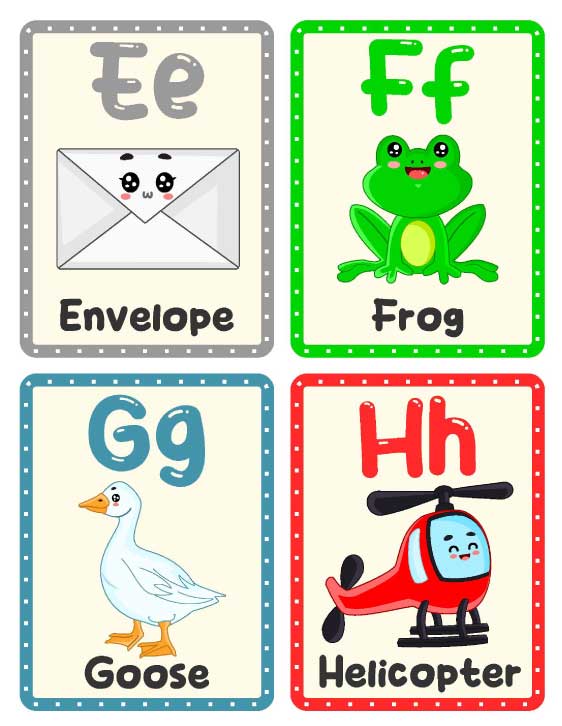
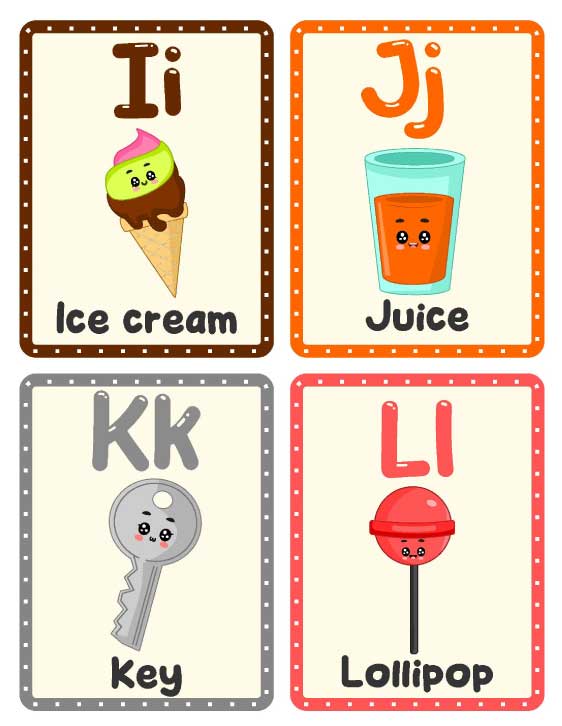
The illustrated objects—such as frog, helicopter, ice cream, and rainbow—expand a child’s vocabulary. Seeing and naming these items helps children associate words with real-world objects.
Visual Learning Skills
Bright, colorful illustrations (like the smiling apple or cheerful umbrella shown throughout the materials) capture attention and support visual memory. Children often remember images faster than text alone.
Fine Motor and Cognitive Skills
When children handle cards, point to pictures, or sort them, they develop coordination and cognitive organization skills. These small actions build important neural connections.
How Parents Can Use This Activity With Their Child
Using alphabet flashcards at home is simple and flexible. Here’s a step-by-step approach to get started:
Step 1: Introduce a Few Letters at a Time
Start with 2–4 cards instead of the entire alphabet. For example, begin with A, B, C, and D. This keeps the learning manageable and prevents overwhelm.
Step 2: Say the Letter and Word Aloud
Hold up a card and clearly say: “A is for Apple.” Encourage your child to repeat after you. Emphasize the beginning sound.
Step 3: Explore the Picture Together
Ask simple questions like:
- “What color is the apple?”
- “Have you eaten an apple before?”
This builds language and comprehension skills.
Step 4: Practice Matching Sounds
Say a sound (like “/b/”) and ask your child to find the correct card (Bucket). This strengthens phonics awareness.
Step 5: Review Regularly
Repetition is key. Brief daily practice sessions are far more effective than long, infrequent ones.
Tips to Make This Activity Fun
Keeping children engaged is essential for effective learning. Here are some ways to make alphabet flashcards more exciting:
Turn It Into a Game
Lay out several cards and call out a letter. Let your child race to find it. This adds movement and energy to the activity.
Use Silly Voices
Say the words in funny voices or animal sounds. For example, croak like a frog when showing the “F” card.
Incorporate Movement
Ask your child to jump when they hear a certain letter or act out the object (like flying like a helicopter).
Celebrate Small Wins
Clap, cheer, or give a high-five when your child identifies a letter correctly. Positive reinforcement builds confidence.
Follow Your Child’s Interests
If your child loves animals, spend more time on cards like goose, snake, or quetzal. Engagement increases when learning feels personal.
Activity Preview
The activity consists of a full set of alphabet flashcards, each displaying a letter pair (uppercase and lowercase) alongside a colorful illustration of a familiar object. For example, children see “A” paired with a cheerful apple, “F” with a smiling frog, and “U” with a bright umbrella. The visuals are playful and inviting, designed to immediately capture a child’s attention and make learning feel like play rather than work.
Each card clearly connects a letter to a word and image, helping children form strong mental associations. As children explore the cards, they begin to recognize patterns—letters have sounds, and those sounds form words they already know. This natural connection between visuals, sounds, and language is what makes the activity so effective. Over time, children become more confident in identifying letters, pronouncing sounds, and recalling vocabulary, all while enjoying the process.
Tracing Letter Z Practice with Fun and Educational Worksheets
Conclusion
Simple activities like alphabet flashcards for kids can have a powerful impact on early learning. They build essential skills such as letter recognition, phonics awareness, and vocabulary all while creating meaningful moments between you and your child.
By keeping the experience playful, consistent, and encouraging, you’re not just teaching letters—you’re nurturing a lifelong love of learning. Small steps each day truly add up, and your support makes all the difference.