Table of contents
Arabic coloring activities play an important role in early childhood education, particularly in supporting language development alongside fine motor and visual skills. By combining simple illustrations with Arabic vocabulary, these coloring pages help young children become familiar with new words while engaging in a calm and enjoyable learning experience. Through structured arabic coloring, preschool and kindergarten learners are introduced to bilingual awareness, early literacy, and creative expression in a developmentally appropriate way.
Octopus: Vocabulary Building and Marine Awareness
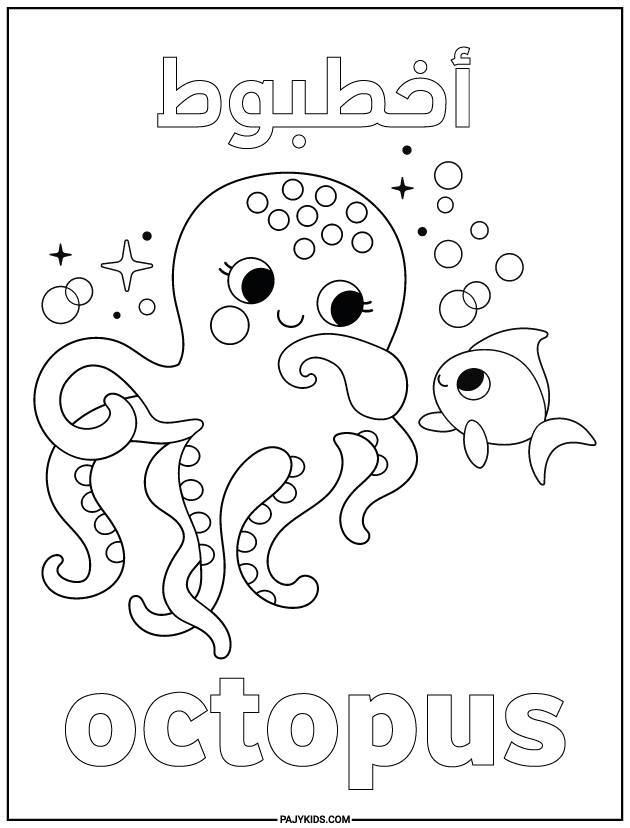
This coloring page features a friendly octopus accompanied by its name in Arabic and English, making it a valuable arabic coloring resource for early vocabulary development. Coloring the octopus helps children improve hand–eye coordination while learning about sea animals. The circular shapes and flowing arms encourage controlled hand movements, and the bilingual labeling supports early language recognition in a playful, non-pressured manner suitable for kindergarten learners.
Butterfly: Visual Discrimination and Symmetry
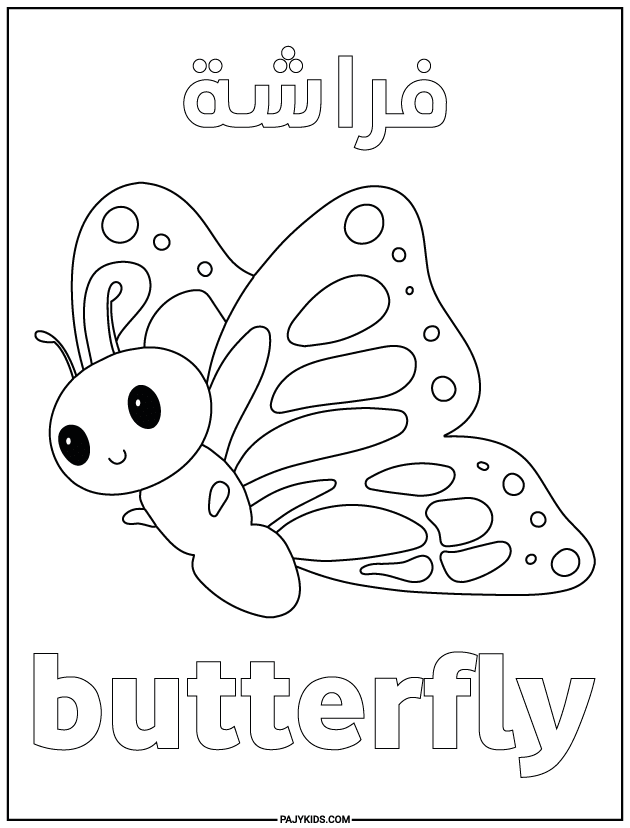
This page presents a butterfly with clearly defined, symmetrical wings and labeled text, supporting arabic coloring as a tool for both visual and linguistic learning. Coloring symmetrical patterns helps children recognize balance and repetition, while the Arabic word reinforces letter recognition and word familiarity. The activity also promotes patience, focus, and aesthetic awareness, which are essential skills during the preschool and kindergarten stages.
Elephant: Animal Recognition and Motor Control
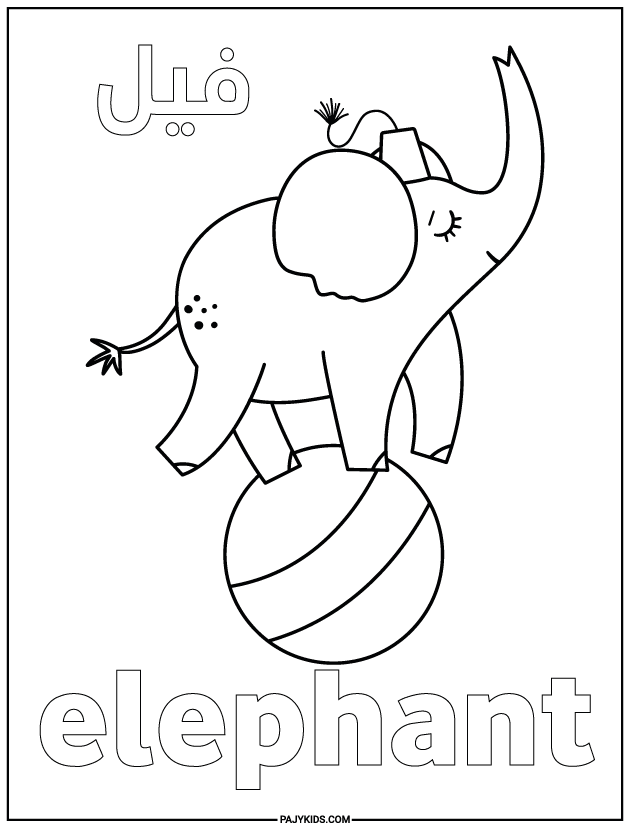
Featuring a cheerful elephant balancing on a ball, this arabic coloring page introduces children to land animals while reinforcing vocabulary through written labels. The combination of larger shapes and moderate details allows children to practice coloring within boundaries, strengthening fine motor control. At the same time, associating the image with its Arabic name supports early word–image connections and builds confidence in language learning.
Bull: Environmental Awareness and Concept Learning
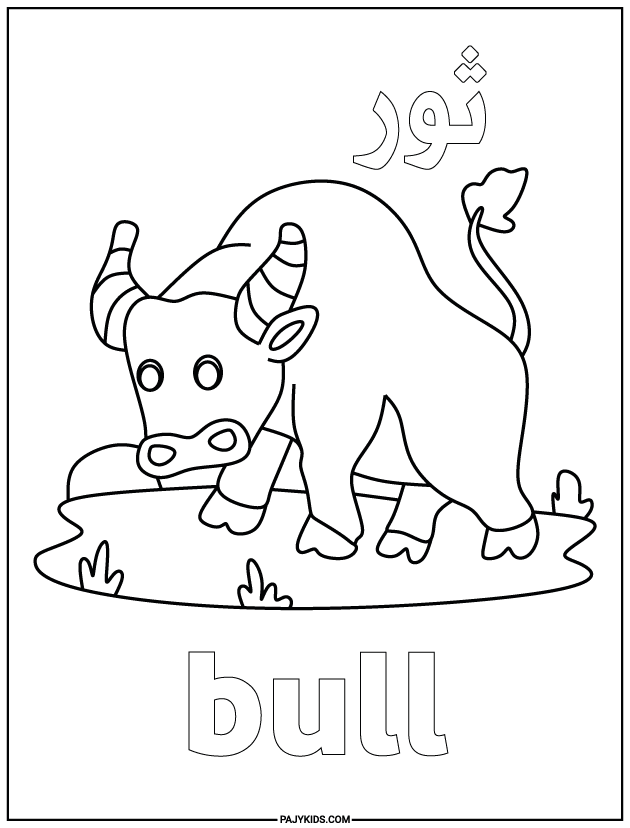
This coloring page shows a bull in a simple natural setting, accompanied by its Arabic and English names. As part of arabic coloring, the activity helps children learn about farm animals and their environments while developing visual perception and concentration. Coloring the ground and surrounding elements supports spatial awareness, and the labeled vocabulary encourages early reading readiness in a supportive, creative context.
Coloring for Preschool: Nature-Themed Learning Activities
Together, these pages highlight the educational value of arabic coloring as more than an artistic activity. Through arabic coloring, children strengthen fine motor skills, expand vocabulary, and build early literacy awareness in a calm and engaging way. When thoughtfully designed, arabic coloring supports holistic development and provides a strong foundation for language learning and school readiness in early childhood education.