Table of contents
Helping children explore the wonders of space can spark curiosity, imagination, and a lifelong love of learning. Introducing basic astronomy concepts at an early age doesn’t need to be complicated in fact, simple visual tools can be incredibly effective. Solar system flashcards for kids provide an engaging and approachable way to introduce planets, stars, and space-related vocabulary.
Young children are naturally drawn to colorful images and clear labels. When learning feels like play, children absorb information more easily and build confidence in their understanding. With the right approach, parents and educators can turn these simple materials into meaningful learning experiences that support both cognitive and language development.
What This Activity Teaches Children
Using solar system-themed flashcards helps children develop a wide range of foundational skills while exploring an exciting topic.
1. Early Science Knowledge
Children are introduced to key elements of space, including the Sun, Moon, and planets like Mercury, Venus, Earth, Mars, Jupiter, Saturn, Uranus, and Neptune. They also learn about additional space objects such as stars, meteors, and satellites.
2. Vocabulary Development
Each card pairs a clear image with a word, helping children connect visual information with language. This strengthens word recognition and expands their science-related vocabulary.
3. Memory and Recall Skills
Flashcards naturally encourage repetition, which supports memory building. Children begin to recognize patterns, recall names, and associate visuals with meaning.
4. Visual Discrimination
The distinct colors and designs of each planet help children notice differences and similarities, improving observation skills.
5. Curiosity and Imagination
Space is inherently fascinating. Learning about astronauts, rockets, and distant planets encourages children to ask questions and imagine possibilities beyond Earth.
How Parents Can Use This Activity With Their Child
Using these flashcards effectively doesn’t require special training—just a bit of intentional interaction.
Step 1: Start With Familiar Concepts
Begin with simple and recognizable objects like the Sun, Moon, and Earth. Talk about how the Sun gives us light and warmth or how the Moon appears in the night sky.
Step 2: Introduce a Few Cards at a Time
Avoid overwhelming your child. Choose 3–5 cards per session and gradually introduce more as they become comfortable.
Step 3: Say the Words Clearly
Point to each card, say the name slowly, and encourage your child to repeat it. Repetition helps reinforce learning.
Step 4: Ask Simple Questions
Engage your child by asking questions like:
- “Which one is the red planet?”
- “Can you find Earth?”
Step 5: Practice Matching and Sorting
Mix the cards and ask your child to group them (e.g., planets vs. space objects). This builds categorization skills.
Step 6: Review Regularly
Short, frequent sessions are more effective than long ones. Revisit the cards daily to strengthen retention.
Tips to Make This Activity Fun
Keeping children engaged is key to successful learning. Here are some practical ways to make the experience enjoyable:
Use a Storytelling Approach
Create a simple story about traveling through space. For example, “We are astronauts visiting each planet!” This makes the activity more immersive.
Add Movement
Let your child “fly” from one card to another like a rocket. Physical movement helps reinforce learning.
Turn It Into a Game
Play guessing games: describe a planet and let your child identify it. For example, “This planet has rings—what is it?”
Use Sound Effects
Make rocket noises or pretend to zoom through space. These playful elements capture attention and make learning memorable.
Celebrate Small Wins
Praise your child when they recognize a card or remember a name. Positive reinforcement builds confidence.
Butterfly Life Cycle for Kids: Easy and Fun Learning Activities
Activity Preview
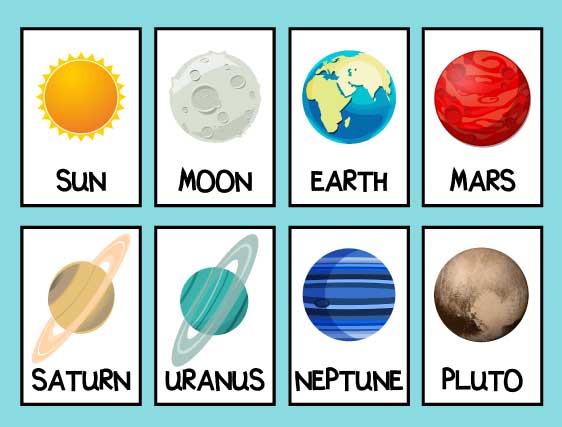
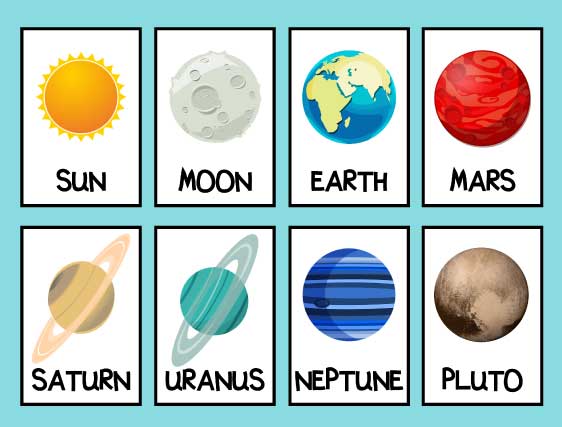
The materials present a set of bright, engaging flashcards featuring key elements of the solar system. Each card includes a bold illustration and a clearly written label, making it easy for children to identify and remember each object. The visuals include major celestial bodies such as the Sun, Moon, and planets, along with space-related items like rockets, astronauts, meteors, and satellites.
Children are encouraged to look at each image, say the name aloud, and begin forming associations between the picture and the word. The designs are simple yet visually distinct, helping children differentiate between objects like Saturn with its rings or the blue tones of Earth. This clarity supports early learners in building recognition skills while keeping the experience enjoyable and accessible.
Beyond identification, the activity opens the door to meaningful conversations about space. Parents can guide children to notice details, compare objects, and ask questions. This not only strengthens understanding but also nurtures curiosity and a sense of wonder about the world beyond our planet.
Conclusion
Simple learning tools can have a powerful impact when used with intention and warmth. Solar system flashcards offer an engaging way to introduce children to science, build vocabulary, and spark curiosity about the universe. By turning these moments into playful, interactive experiences, parents and educators can create meaningful learning opportunities that children will remember and enjoy. Even a few minutes a day can nurture a love of discovery that lasts a lifetime.